
There is a certain point when a parking lot stops looking like a surface that gets cleaned and starts looking like a surface that gets ignored. Traffic film builds on traffic film. Grease finds its way into the concrete. Tire residue darkens the stalls. The people who notice it first are not the ones managing the property. They are the tenants, customers, and visitors pulling in every day. By the time the problem is visible, it has usually been there for a while.
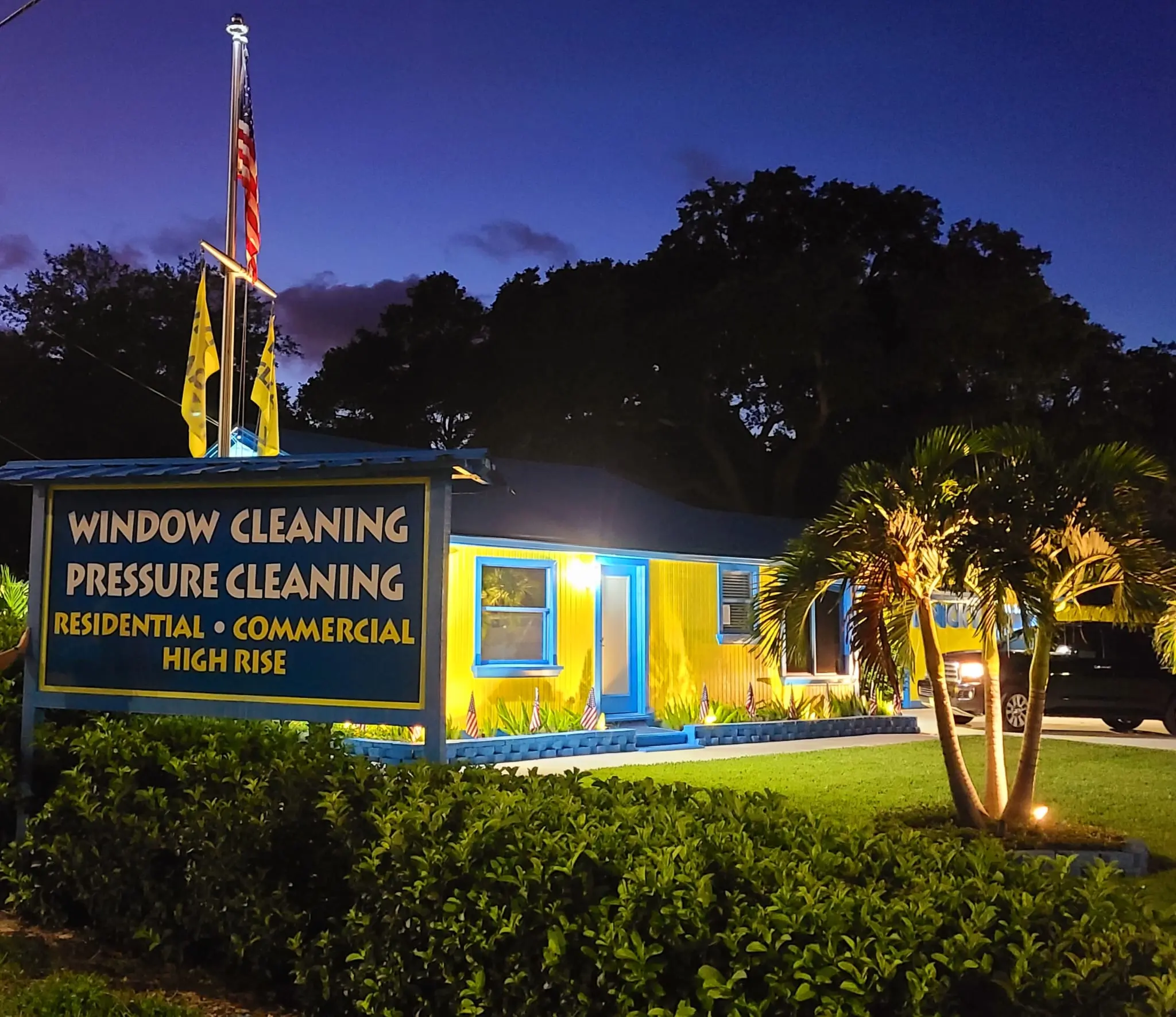
Finicky Window Cleaning has been handling commercial exterior cleaning across this area since 2002, and parking lot and garage work is a meaningful part of what we do. We serve property managers, HOA and condo boards, facility teams, and business owners who want the job done correctly, not just done. The name “Finicky” reflects a real standard our team holds to on every property we touch. We are a faith-based, family-owned company, and that shapes everything from how we treat a client’s property to how we communicate when something needs attention. Every technician on your job is a trained member of our in-house team. We do not use subcontractors, which means you are not getting whoever was available that morning. You are getting our people, working to our standards, every time.
We have cleaned government buildings, hospitals, banks, and multi-tenant commercial properties, and we bring that same preparation and attention to every parking lot and garage project we accept. When operational disruption is a real concern, we schedule work after hours or overnight. For clients who need ongoing service rather than a one-time visit, we offer monthly, quarterly, and bi-monthly maintenance programs built around your property’s specific needs.


Our minimum service price is $300, and the average cost for our exterior cleaning services runs between $300 and $1,000. That range covers our work across service types, and commercial flatwork like parking lots and garages is always quoted based on the specific job. The variables involved, square footage, soil severity, site access, traffic control requirements, and runoff handling, mean that a number you can actually rely on takes more than a phone call to produce. We can gather initial details over the phone, but most commercial parking lot and garage projects require an on-site inspection before we can give you a figure that reflects what the job actually involves. Exact pricing details are available upon request.
Several things directly shape how much time, labor, chemistry, and coordination a parking lot or garage cleaning requires. Knowing them upfront keeps expectations grounded.


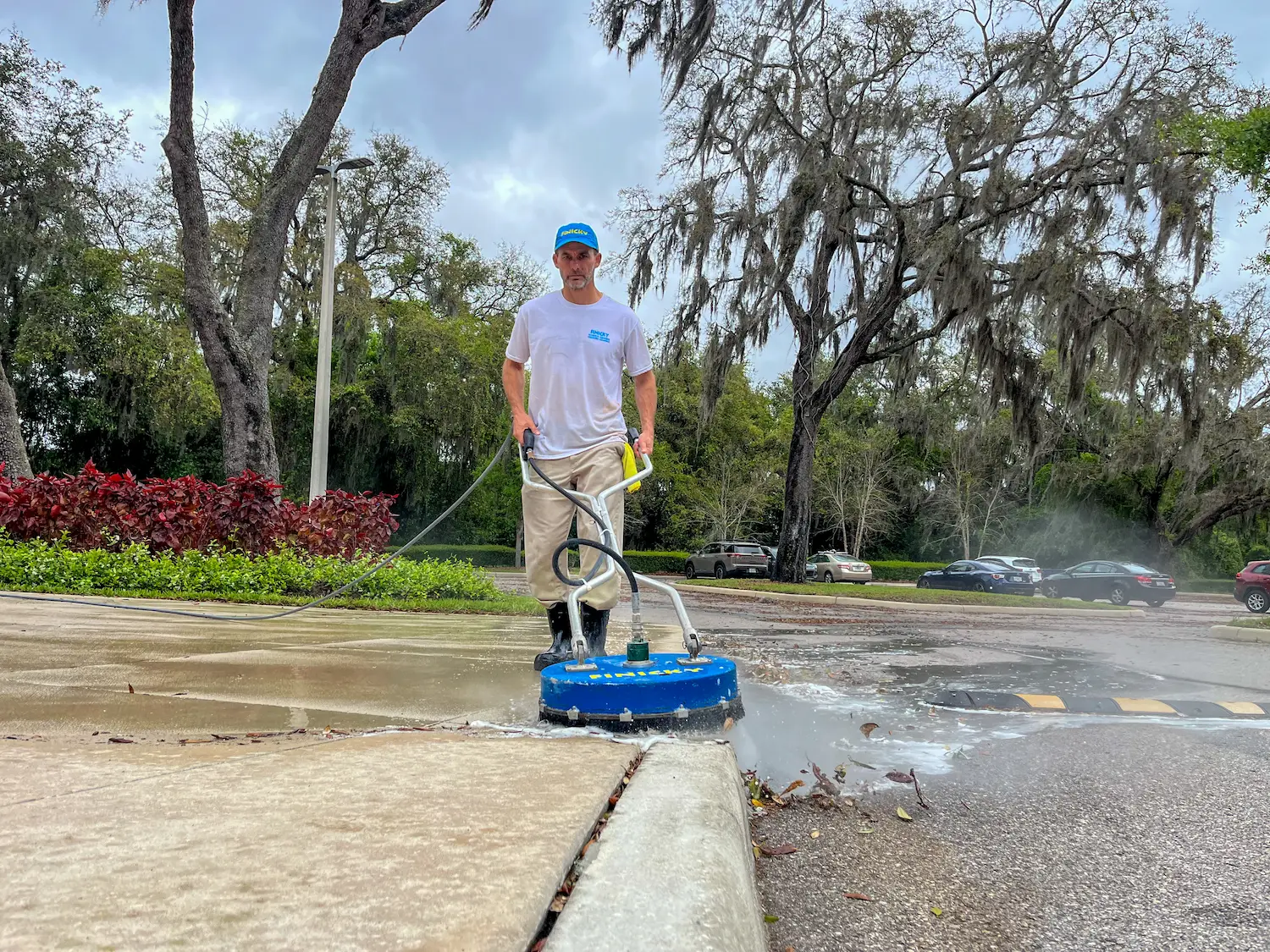
Commercial parking surfaces carry a contamination profile that is categorically different from what you find on a residential driveway. Drive lanes accumulate layers of traffic film. High-turnover stalls hold baked-in tire residue. Parked vehicles leave fluid drips that spread over time. Pedestrian entryways carry in whatever is tracked in from the wider property, and grease and grime fill in the gaps across everything in between. The volume of vehicles, the frequency of spills, and the scale of the surface all demand an approach matched to those conditions. Surface cleaners designed for commercial flatwork, combined with the right chemistry for the soil type present, produce the even and consistent result that a well-maintained property requires.
Garages bring challenges that open lots do not. Ramped surfaces carry drainage in directions that affect how we stage rinse water and sequence our passes. Tight vehicle lanes running alongside active pedestrian paths require a more deliberate safety setup throughout the job. Multi-level structures often need to be worked in sections to keep access available while cleaning is underway on other floors. After-hours or overnight scheduling is usually the most practical choice for garages serving an active tenant population, since it removes the conflict between cleaning equipment and live traffic entirely. We plan our approach around the specific layout and constraints of each structure.
Some zones within a lot or garage accumulate soil at a noticeably higher rate than the surrounding flatwork, and they need to be treated accordingly. Areas near loading docks pick up equipment grease and service bay runoff. Dumpster-adjacent zones develop concentrated organic buildup that requires more aggressive treatment than a standard drive lane. Main entrance corners and high-turnover stalls absorb years of tire rubber and fluid drip at a pace the rest of the surface does not match. In commercial settings, degreasers are part of the standard approach more often than in residential work because the soil types present call for them. Hot water capability makes a real difference on stubborn grease that cold water and chemistry alone cannot fully cut through. On aged oil staining in porous concrete, we talk through realistic expectations before we start: significant improvement is usually achievable, but complete removal is not always possible once a stain has had time to penetrate.

Large commercial flatwork is easy to rush. Corners get skipped. Edges get missed. The difference between a thorough cleaning and a fast one becomes obvious when you are looking at several thousand square feet of exposed surface. Our team works to a standard that produces even coverage across all drive lanes and stalls, careful attention to the zones that are easiest to overlook, and consistent results across multi-zone properties where inconsistency is immediately visible. That standard applies whether someone is watching or not.

Every person who shows up on your property is part of our team, trained to our procedures and working under our direct supervision. No subcontractors. That distinction matters in a commercial context because it means the crew is not a variable. You get the same methods, the same conduct, and the same quality of work from one visit to the next, with a direct line of accountability if anything ever needs to be addressed.

A large share of our commercial pressure cleaning work happens after hours or overnight because active commercial properties often cannot afford to restrict access during business hours. We work around your operational schedule, not the other way around. For multi-tenant properties, coordination may include advance vehicle-move notices, which the property manager can handle or which we can support directly depending on what the property and management team prefer. Staged cleaning plans are available for large active lots, so sections can be addressed in sequence while the rest of the property stays open and accessible.

Our commercial flatwork setup includes multiple pressure cleaning machines, surface cleaners for uniform coverage across large paved areas, a hot water heater for stubborn grease and debris, and a range of wand and nozzle configurations matched to different surface types and soil conditions. Degreasers are a routine part of our commercial toolkit because the contamination profile on commercial surfaces calls for them. For work on building-adjacent surfaces that require height access, our capabilities extend to lift work, rappelling, and swing stage when the project calls for it.

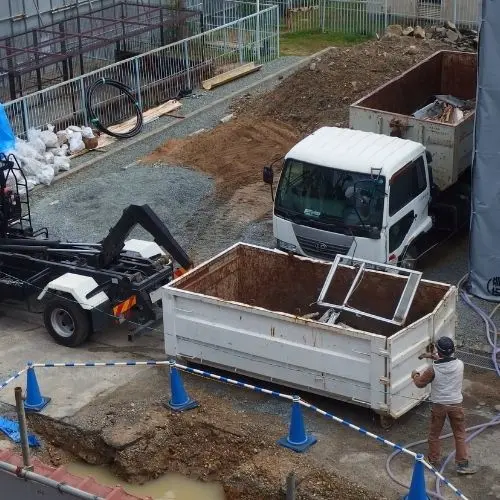
Every commercial job starts with a proper safety setup before cleaning begins. We deploy cones and signage to mark active work zones, establish traffic direction where vehicle flow requires it, place rubber hose mats over sidewalk crossings, and set up caution tape or barriers where additional separation from foot traffic is needed. Our team keeps their conduct professional throughout every job: communication stays appropriate, there is no disruptive noise, and we work around specific requests from property managers regarding sequencing or site access.

Commercial cleaning decisions often require more paperwork than a residential job. For complex sites, we can provide a detailed scope of work and scheduling plan, a certificate of insurance, and references from comparable commercial properties we have served when that is helpful to your process. Not every project needs the same level of documentation, but we can match what the management team or procurement process requires. The goal is to make bringing us on straightforward, not to add steps to an already involved process.

We have been serving this area since 2002. More than two decades of consistent work produced our 4.9-star Google rating backed by over 100 reviews, and the majority of our new commercial clients come through referrals from existing ones. We are BBB Accredited and an IWCA member. For HOAs, condo associations, and commercial facility teams evaluating a new vendor, a company with that kind of documented history and those industry affiliations carries significantly less unknowns than one without them.

A phone call can gather initial details, but it cannot tell us what a commercial lot or garage actually requires. For most projects, we schedule an on-site inspection to walk the property before any numbers are discussed. During that visit, we assess total square footage and layout across drive lanes, stalls, walkways, ramps, and any garage levels. We evaluate soil severity, identify specific stain types, note drainage patterns and any sensitive areas, and map vehicle and pedestrian flow to determine what traffic-control setup the job will require. We also identify the best water source option, whether client water, coordinated neighboring sources for large communities, or a fire hydrant hookup for very large commercial work, and we confirm whether hot water and degreasers will be part of the approach before we put a number to the scope.
After the site evaluation, we put together a proposal that matches what the job actually requires. For complex commercial sites, that may include a detailed scope of work and scheduling plan, safety and logistics notes, a certificate of insurance, and references from comparable properties we have served when those are useful to your process. Not every project calls for the same depth of documentation, but we size the proposal to what the property management team and decision-maker need to move forward.
Once scope is agreed upon, we schedule the job around how your property actually operates. After-hours and overnight timing is often the right call for high-traffic lots and garages. Our office takes calls Monday through Friday from 8 a.m. to 3 p.m., and calls that come in outside those hours are captured and followed up with our after hours answering service, so nothing gets missed. For properties with residents or active tenants, vehicle-move planning and notices are coordinated in advance, either managed by the property management team or supported directly by us depending on what works best for the type of complex.
Before cleaning starts, our crew establishes a proper safety perimeter across the work area. Cones and signage go up to mark active zones. Traffic direction is set up for any lanes staying open. Rubber mats go down over hose crossings at pedestrian sidewalks. Caution tape or barriers are placed where additional separation from foot traffic is needed. The van and trailer are positioned for both safety and equipment access. Only after the site is properly staged do we begin surface work.
We walk the entire surface before applying anything. We look for existing damage or concerns that need to be flagged with the property contact before we proceed, and we test our chemistry in a small area first where appropriate to confirm the approach is right for the surface condition. If landscaping borders the lot, we pre-wet any adjacent plantings before chemical application begins. Active work zones stay clear of pedestrians and animals throughout the service.
We use a proprietary chemical solution that is environmentally safe for humans and pets. In commercial settings, degreasers are part of the application more often than in residential work because the soil present near loading areas, dumpster zones, and high-turnover lanes requires a stronger approach. We dilute appropriately and apply responsibly, with surrounding areas protected based on the site conditions identified during setup.
Surface cleaners are our primary tool for large flatwork because they produce a uniform, streak-free result across wide areas more efficiently than wand cleaning alone. For stubborn grease, heavy tire residue, and built-up accumulation, our hot water capability makes a real difference on the types of soils that cold water cannot fully release. Nozzle and wand selection is matched to the surface type and conditions present. On severely stained surfaces, particularly older oil penetration in porous concrete, we have the honest conversation about expectations before we begin: significant improvement is typically achievable, but full removal is not always possible.
Runoff handling varies by property and by any applicable local requirements. Some commercial sites require water extraction. For most jobs, we direct rinse water into the right places based on the site’s drainage layout and what was confirmed during planning. We treat runoff management as a standard part of site coordination rather than a separate decision made on the day.
When cleaning is complete, we walk the entire serviced area to check for missed zones, uneven results, or any sections that need additional attention. Every part of the agreed scope is verified before we start breaking down equipment. When a property contact is available, we walk the site with them to confirm the work meets expectations.
Our communication runs from initial confirmation through post-service follow-up without gaps. Clients receive a confirmation email with appointment details and a prompt to confirm the booking. A reminder email goes out seven days before the scheduled date, followed by a text two days out. The lead technician contacts the property contact before travel with an ETA. On arrival, our team introduces themselves, reviews the scope and the agreed price, and confirms any last details before starting. Once done an invoice is emailed by the office. Two to three days after the service, an automated follow-up requests feedback and a review.


We follow all OSHA, state, federal, and county regulations and applicable environmental laws on every commercial job we perform. Florida commercial properties span a wide range of types and regulatory contexts: condos, HOAs, retail centers, medical facilities, and municipal properties each carry their own site rules and runoff expectations, and we treat those differences as part of proper job planning. Compliance is not a separate line item for us. It shows up in how we handle traffic control, protect pedestrian areas, route and mat our hoses, and schedule work around the property’s operational needs. When after-hours timing reduces safety risk and keeps the property running without disruption, we build that into the schedule from the beginning. As a member of the IWCA, we operate to safety standards that exceed the OSHA baseline, and that standard of care extends into how we approach commercial site safety on every type of job we take on.

We back every parking lot and garage cleaning with a 100% satisfaction guarantee and a 30-day clean guarantee. If a concern comes up after we leave, we start by gathering information. We want to understand exactly what the issue is, confirm what was agreed upon, and determine whether the concern falls within the scope of the job. Once we have the full picture, we schedule a return visit to address any missed or unsatisfactory areas. A job is not closed until the client is satisfied with the result. We carry complete insurance coverage for our employees, our customers’ property, and our vehicles, and we can provide a certificate of insurance for commercial contracts as a standard part of our documentation package.


Most jobs are scheduled based on the size and complexity of the property. Larger sites may take longer or require work across multiple nights. The timeline depends on total square footage, the degree of grease and grime present, traffic conditions, and whether the job needs to run after hours to reduce disruption to the property. For commercial projects, we assess the site in person so we can give you accurate timing expectations before work begins.
Yes. Cleaning can often be coordinated in sections to work around the property’s operational needs. Whether that approach is practical depends on the site layout, traffic level, and what the customer prefers. Some locations are safer and more efficient to clean after hours, while others can be staged during the day without significant disruption. We work with the property contact to choose the approach that fits the situation best.
We have handled it both ways. In some cases, the property manager manages notices to residents. In others, we have posted notices near mailboxes so residents know when vehicles need to be moved or when work is coming. The right approach depends on the property type and the management team’s preference, and it gets worked out during the scheduling process.
It depends on the scope and how much surface access the job requires. In multi-vehicle commercial environments, access planning often matters, and we may coordinate advance notices so vehicles can be moved when needed. We recommend working through this during the scheduling conversation so the cleaning can cover the full agreed area safely and completely.
We set up and manage jobsite safety as part of our commercial service. That includes cones, traffic direction where needed, and rubber mats over hose crossings at pedestrian walkways. If a specific property requires additional on-site staffing or security beyond what our crew provides, that is discussed and coordinated with the customer during planning.
We use the client’s on-site water in most cases. For larger communities, access can sometimes be coordinated across different on-property locations or neighboring sources. For very large commercial jobs, a fire hydrant hookup may be necessary. We identify the right option during the on-site evaluation and plan for it before the job begins.
Yes. Heavy storms or unsafe conditions may require rescheduling. We coordinate timing and next steps directly with the customer and communicate as early as possible when a change is needed. Getting the job rescheduled quickly is a priority.